Old HPS growers used watts because that’s all they had. But LEDs changed the game.Plants eat photons, not watts. PAR is 400–700nm, but high-value crops can use 385–730nm range:
UV (385nm) – triggers defense → more resin, terpenes (potency, flavor)
Far-red (730nm) – increases yield, speeds up flowering
So forget “equivalent watts.” Focus on photosynthetic photons.Let’s break down PPF, PPFD, and PPE– and what each one means for your plants.
1. PPF – The total number of useful light photons (plant food) the lamp gives off.
Higher PPF = more total photons = under the same area, the plant has a greater chance to get more energy and grow better.
2. PPFD – How much light lands on the leaves
It measures how many photons land on a specific spot on your canopy every second.
PPF = total light coming out of the lamp.
PPFD = how much light actually hits your plant's leaf at that spot.
Why PPFD is crucial - different growth stages need different densities:

Note for seedlings: During germination or early rooted cutting stage, the safest range is actually 75–150 µmol/m²/s.
PPFD changes with height – measure at canopy level.
Before buying: check PPFD map (center vs. corners). If corners are 50% lower, edge plants starve.
3. PPE – Does this lamp save electricity or waste it?
Low PPE lights – Waste electricity and run hot.
Most of the electricity turns into heat, which plants can’t eat. You’ll pay higher bills and need air conditioning to cool down.
High PPE lights – Save electricity and stay cool.
Almost all the electricity turns into light that plants love. With the same bill, your plants get more food and grow better.
2.6–2.8+: Excellent (main light)
2.2–2.6: Good for home tents
1.5–1.8: Fine for supplemental or low-light plants
<1.5: Garbage. Don’t buy.

What to care about, by crop & space

PPFD uniformity over raw power. Corners matter.PPE 2.2+ is fine.
Commercial greenhouse
PPE is king. A 0.1 difference saves thousands.PPFD just needs to hit DLI target.
One quick math trick
1 sq ft = 0.0929 m²
PPF needed (μmol/s) = target PPFD × (area in sq ft × 0.0929) Or: PPF needed = target PPFD × area in m² (here's the sq ft version)
Example: 4x4 tent = 16 sq ft
16 × 0.0929 = 1.4864 m²
1.4864 m² × 800 PPFD = 1,189 µmol/s
Warning: If you forget the 0.0929 and just do 16 × 800 = 12,800 µmol/s – that's a huge mistake. That much PPF is impossible for a 4x4.If a light claims to flower a 4x4 with 400W... it's lying. Math doesn't lie.
By following these methods, do you now know how to better select and identify the suitable plant lights for you?
If you have any questions, please feel free to contact us:sales@hortibest.com
 EU PPWR Packaging Regulation Takes Effect Aug 12 | How Hortibest LED Grow Lights Fully Comply
 HPS to Tunable LED Grow Lights: Why Your Old Irrigation Schedule Will Cost You Yields
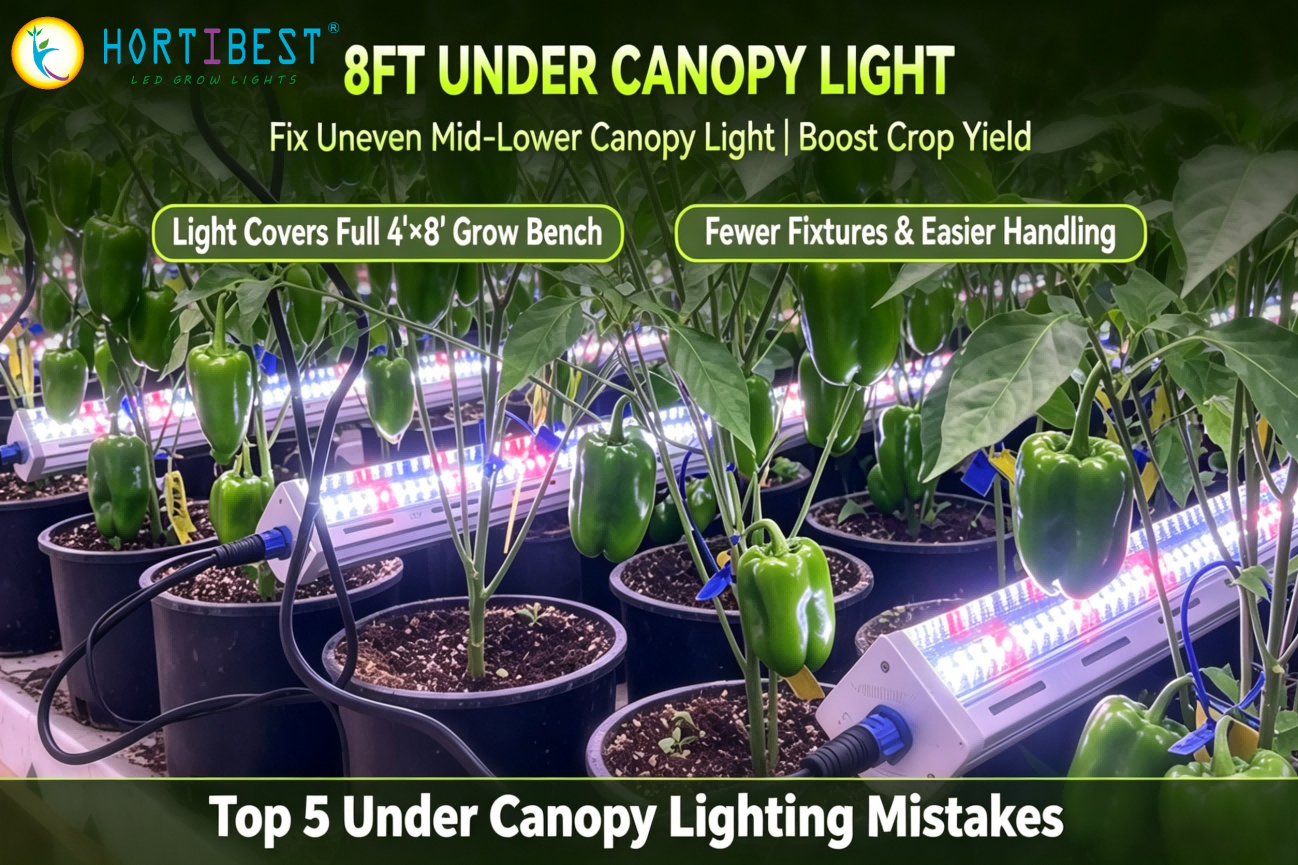 Top 5 Under Canopy Lighting Mistakes Commercial Growers Make | UCL Best Practices
 40% Higher Winter Strawberry Revenue: Minnesota Commercial Greenhouse Fixes High HVAC Costs & Pale Berries with Shark‑2600 Linear LED Grow Lights


