
As we step into the 2026 growing season, many of us in the horticulture industry are standing at a significant crossroads. With new commercial cultivation programs launching across the United States, growers who have spent years operating in grey areas or small-scale setups are now preparing to do what we’ve always talked about: building efficient, compliant, and profitable operations at scale.
If you are reading this, you are likely in the planning phase for a commercial facility. You’ve probably spent years mastering your craft under the familiar amber glow of High-Pressure Sodium (HPS) fixtures. You know how they feel, how they heat a room, and how your plants respond to them. But as we move into an era of legal, commercial production, the rules of the game have changed. We aren't just growers anymore; we are manufacturers of high-value botanical products, and we need to think like CEOs.
The single most critical decision you will make—before the HVAC, before the benching, before the irrigation lines—is your lighting infrastructure. It dictates your energy budget, your cooling load, and ultimately, your crop quality and consistency. Here is my practical guide to choosing the right LED technology for the modern commercial grower, based on lessons learned from the transition happening in the field right now.
Let’s look at the landscape. States like Washington are refining their licensing structures, creating clear tiers for producers based on square footage and cultivation methods. Whether you are a Tier 1 or Tier 2 producer, the expectation from regulators and the market is the same: consistency and efficiency. You cannot afford the variability that comes with outdated tech.
The days of "hang it and forget it" are over. We are now seeing legislative definitions that specifically call out "indoor cultivation" versus "mixed-light," which impacts licensing fees and operational allowances. To compete in this regulated environment, your light strategy must be defensible, repeatable, and data-driven.
If you are building a new facility or retrofitting an old barn, LED is the only logical choice. I ran HPS for years. I know the argument about the initial cost. But let’s look at the total cost of ownership.
Modern LED fixtures consume significantly less electricity to deliver the same, if not better, Photosynthetic Photon Flux Density (PPFD) to the canopy. But the savings go beyond the utility bill. Because LEDs produce less radiant heat, your HVAC requirements drop substantially. You are essentially paying for the light, not paying again to extract the heat it creates.
However, not all LEDs are created equal. The market is flooded with options, but as commercial operators, we need to look beyond the wattage and look at the architecture of the light.
One of the biggest headaches in commercial cultivation is light uniformity. With traditional single-bar or cob-style LEDs, you often get a "hot spot" directly under the light and a significant drop-off at the edges. This forces you to overlap footprints wastefully or accept that your peripheral plants are larfy and underdeveloped.
This is where the form factor of the fixture becomes as important as the chip inside it.
In my facility, I’ve been testing a configuration that solves this specific spatial challenge. The Hortibest Octopus-G Series OG8-3300 is designed with a multi-bar "Octopus" configuration specifically engineered to cover a true 4' x 4' footprint. Unlike older bar designs that leave shadowing, this 900w fixture spreads the diodes out to ensure the photon density is uniform edge-to-edge.
Why does this matter for your bottom line?
Uniformity means every plant in the canopy receives the same light intensity. This synchronizes growth rates, transpiration, and irrigation needs. You walk into the room and see a flat, even canopy, not a patchwork of plants stretching toward the brightest point. This uniformity is the foundation of a predictable harvest schedule.
Here is another practical pain point for new commercial growers: you usually have two distinct zones—vegetative and flowering—but sometimes, you need to pivot.
Maybe you are contract-growing for a processor who suddenly wants more of a specific terpene profile. Maybe you have a new strain that stretches too much under your standard veg spectrum. With HPS, you were stuck. You had one spectrum: orange.
The OG8-3300 offers two distinct personalities that solve this: the Tri-Channel Tunable Spectrum and the FIX Spectrum.
One of the persistent myths I hear from HPS veterans is that LED light doesn't "penetrate" the canopy as well. This usually stems from using early-generation LED chips that lacked sufficient green wavelengths.
We now know that green light is critical. While blue and red light are absorbed by the top layer of leaves, green light penetrates deeper into the plant tissue, driving photosynthesis in the lower canopy. The OG8-3300’s full-spectrum design ensures that the lower bud sites aren't starved, turning what used to be "trim bin" material into solid, sellable flower. This deeper penetration effectively increases your usable yield per square foot without increasing your plant count.
When I built my first commercial room, I underestimated the cost of electrical infrastructure. Running dedicated lines to every single light is expensive.
Modern fixtures need to play nice with the grid. The OG8-3300 allows for daisy-chaining (linking multiple fixtures). This feature alone cut our installation costs significantly. Instead of pulling wire to a junction box for every light, we ran a single line to a series of lights. This is a game-changer for large-scale deployments.
Furthermore, with DLC certification, these fixtures qualify for utility rebates in many states. We are talking about hundreds of dollars back per fixture, which directly offsets the initial investment gap compared to HPS.
If you are taking the plunge this year, here is my advice based on real-world application:
1. Measure, Don't Guess: Don't trust the app on your phone. Get a PAR meter. Map your 4x4 area. With the OG8-3300's uniform design, you should see minimal variation across your grid, but you need to verify your hanging height (usually starting around 18-24 inches) to hit your target DLI.
2. Adjust Your Environment: LED on plants look different than HPS on plants. Because LEDs don't radiate heat the same way, your leaf surface temperature will be cooler. You might need to bump up your ambient air temperature slightly to maintain the ideal Vapor Pressure Deficit (VPD). Watch your plants, don't just read the air thermostat.
3. Rethink Nutrition: Plants grown under intense, full-spectrum LED often have higher metabolic rates. Be prepared to adjust your feed charts. You may find they demand more calcium and magnesium to support the denser cell structure and flower production.
4. Consider the Layers: As your plants mature, remember that the top canopy will block light. For dense, multi-crop strategies, look into inter-canopy lighting solutions to supplement the lowers, but starting with a high-penetration top light like the OG8-3300 gets you 90% of the way there.
The transition to legal, commercial cultivation is a transition to professionalism. It means leaving behind the "hacks" of the past and adopting technology that provides consistency, efficiency, and control.
The Hortibest OG8-3300 isn't just another LED; it is a solution to specific commercial problems—uneven canopies, lack of spectral control, high installation costs, and utility waste. Whether you choose the "set it and forget it" reliability of the FIX spectrum or the agronomic flexibility of the Tri-Channel, you are investing in a tool that treats your plants like the high-value crop they are.
As you size up your space and calculate your ROI this season, look for fixtures that offer true 4x4 coverage, robust IP ratings for humid environments, and the spectral integrity to carry your crop from clone to finish. Your bottom line—and your plants—will thank you.
 EU PPWR Packaging Regulation Takes Effect Aug 12 | How Hortibest LED Grow Lights Fully Comply
 HPS to Tunable LED Grow Lights: Why Your Old Irrigation Schedule Will Cost You Yields
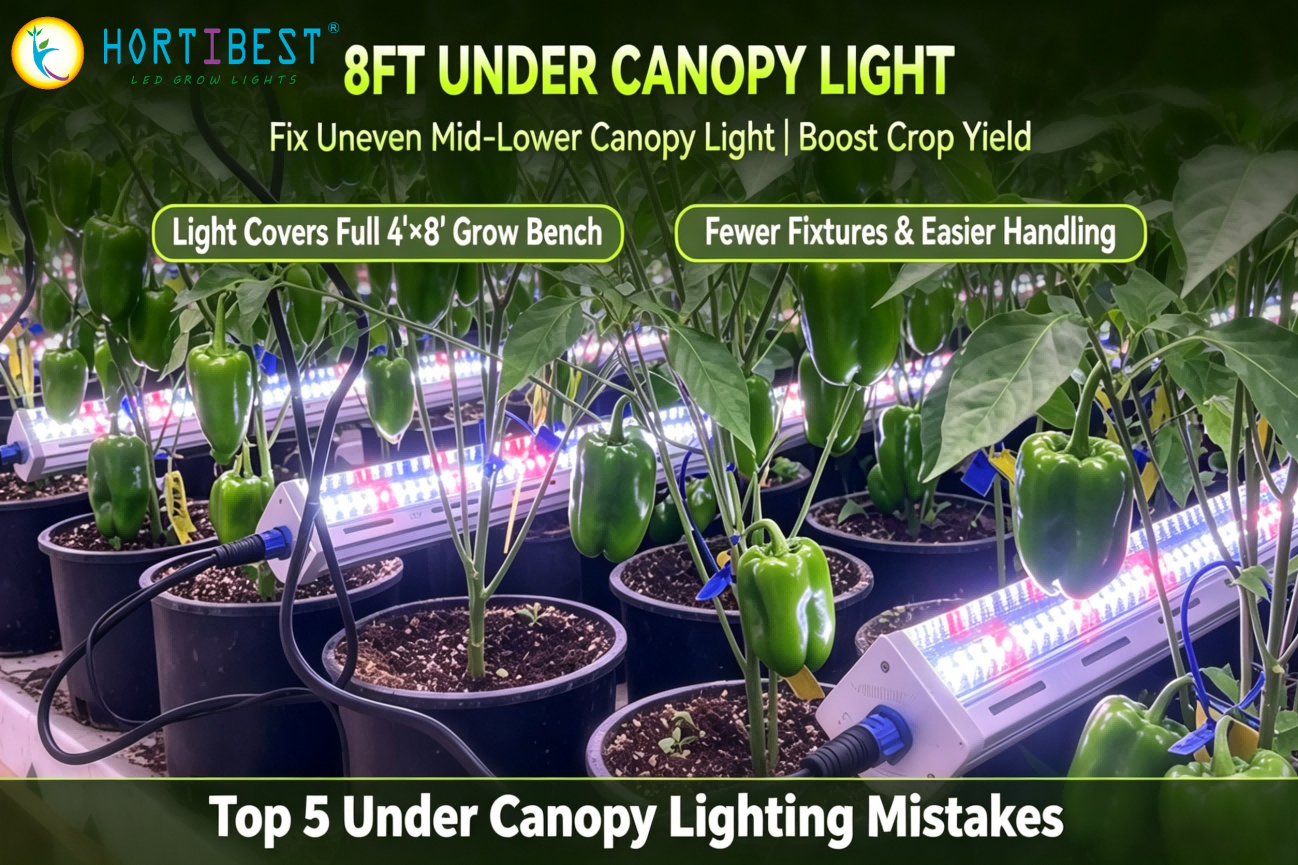 Top 5 Under Canopy Lighting Mistakes Commercial Growers Make | UCL Best Practices
 40% Higher Winter Strawberry Revenue: Minnesota Commercial Greenhouse Fixes High HVAC Costs & Pale Berries with Shark‑2600 Linear LED Grow Lights


