Far-Red Lighting Fixes Low-Light Fruit Drop for Bell Pepper Greenhouses

Views : 91
Author : Cherry
Update time : 2026-07-08 09:39:18

Commercial greenhouse growers worldwide face the same profit killer: insufficient natural light. Cold cloudy winters in North America & Northern Europe, dense canopy shading in Dutch glasshouses, and light-blocking disaster-proof frames in Northern Japan all trigger heavy flower/fruit drop on bell peppers, tomatoes and berries. Basic fixed-spectrum LED lights fail to balance vegetative and reproductive growth, leading to fluctuating harvests and poor ROI.


  • Miyagi is the leading prefecture in Japan for bell pepper shipment volume.A two-year trial from Japan’s Miyagi Agricultural Research Center delivers a clear solution: independently tunable far-red (730nm) lighting optimizes plant structure, boosts inner-canopy photosynthesis and locks consistent fruit set under low-light conditions. Crops need distinct spectrum ratios at each growth stage, which single/dual-channel lamps cannot match.

    Two mainstream lighting solutions are available on the market, neither universally superior—performance depends on planting scale, space structure and operation cycles. All practical drawbacks and advantages including power waste, ceiling load, light decay and electricity expenses are covered below.

    Solution A: Basic Fixed-Spectrum Single-Channel LED Lights
    Applicable Scenarios: Hobby growing spaces under 4ft width, small-scale seedling propagation, amateur trial cultivation of bell peppers

  • Key Advantages for Small-Scale Use
    1. Moderate power output avoids PPFD overload in enclosed small tents; no leaf or fruit burn, so growers do not need to dim lights constantly to cut wasted power consumption.
    2. Lightweight body works with simple hanging brackets; no structural reinforcement required for weak domestic ceiling supports.
    3. Low upfront purchase cost lowers trial risk for new growers; integrated full spectrum covers basic growth needs from seedling to harvest.

    Inherent Limitations for Commercial Greenhouse Deployment
1. No independent FR adjustment channel, flower drop issues under low light cannot be fully resolved.
2. Poor PPFD uniformity with sharp light attenuation at bed edges, leading to inconsistent fruit size and ripening speed across the greenhouse.
3. Low IP rating (mostly IP44) with high failure rates under persistent irrigation mist and high humidity inside greenhouses.
4. Low luminous efficacy (below 2.0 μmol/J). Greenhouses run supplemental lighting 12–16 hours daily year-round, creating substantial monthly electricity overhead.
5. Short service life with only 2–3 years of warranty; severe light decay appears after 2 years, driving high recurring replacement and maintenance costs for large farms.

Solution B: Tri-Channel Independently Tunable Commercial Lighting Systems

Applicable Scenarios: Standard 4’×4’ growing beds in commercial glasshouses, year-round continuous bell pepper production, high-latitude regions with chronic low light, mixed crop rotation farms.


Core Technical Merits Matched to Bell Pepper Cultivation Logic

Three isolated adjustable channels (450nm Blue, 660nm Deep Red, White + 730nm FR) allow custom spectral tuning aligned with the standardized bell pepper light recipe from Japanese agricultural trials:


Commercial-Grade Hardware Benefits vs Basic Single-Channel Lights
1. Uniform 1650 PPFD fully covers standard 4’×4’ growing beds, the mainstream bench size widely adopted in the Netherlands, Canada, USA and Japan; zero dim zones ensure consistent bell pepper growth across the entire planting area.

2. IP65 waterproof construction withstands irrigation mist and high humidity, far more reliable than IP44 basic fixtures.

3. 0–10V dimming and daisy-chain group control are compatible with centralized European greenhouse automation systems. Wide AC200–277V input fits global grid standards. DLC, CE and UL certifications allow North American growers to apply for energy rebates to shorten equipment payback periods.

4. Superior long-term economic efficiency: 3.3 μmol/J high luminous efficacy cuts annual lighting electricity bills drastically compared with low-efficiency basic lights. A 5-year manufacturer warranty limits light decay to only 10% over the service cycle, slashing recurring replacement labor and hardware costs for commercial operations.
5.
Foldable aluminum design reduces shipping volume by 40% to lower bulk farm delivery costs. Beyond bell peppers, its customizable spectrum adapts to strawberries, blueberries, tomatoes and cut flowers, supporting mixed rotation planting on diversified commercial farms.

Frequently Asked Technical Questions

Q1: Is high-power tri-channel commercial lighting such as the OG8-3300 necessary for small hobby greenhouses growing bell peppers?

A1: It depends on your planting scale. Small hobby greenhouses can choose compact single-spectrum grow lights suitable for small areas. Our OG8 series provides multiple wattage options to fit different farm sizes: OG8-2700 for medium commercial beds, OG8-3300 for standard 4’×4’ beds with high bell pepper yield demands.

Q2: Which greenhouses achieve positive ROI after investing in tri-channel tunable lighting systems like the OG8-3300?

A2: Standard commercial greenhouses in low-light high-latitude zones with year-round bell pepper planting benefit most. Tunable far-red light stabilizes fruit set and boosts crop quality. Higher yields and energy savings can cover the initial fixture cost quickly. You can select matching OG8 models per your growing area.


Related News
Read More >>
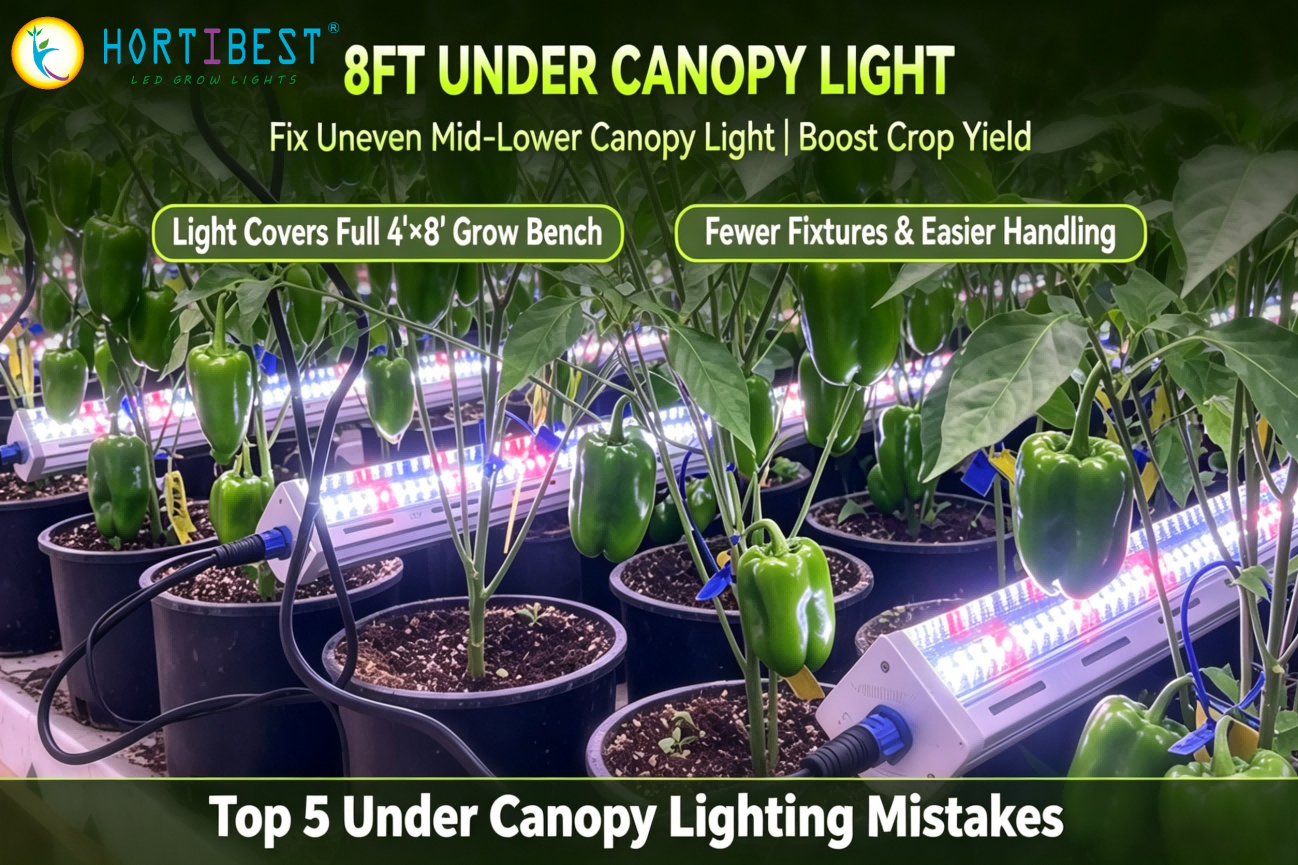
Top 5 Under Canopy Lighting Mistakes Commercial Growers Make | UCL Best Practices Top 5 Under Canopy Lighting Mistakes Commercial Growers Make | UCL Best Practices
Aug .03.2026
Many commercial indoor growers adopt Under Canopy Lighting to lift crop yields, yet costly errors wipe out lighting investment returns. Poor defoliation strategies, mismatched irrigation schedules, improper light acclimation, flawed trellis setups and overcrowded plant density are the top five under canopy lighting mistakes limiting harvest performance. Explore actionable grow room solutions to avoid light stress, uneven maturation and wasted UCL power, helping cultivators gain stable, higher profits from supplemental mid bottom lighting.
40% Higher Winter Strawberry Revenue: Minnesota Commercial Greenhouse Fixes High HVAC Costs & Pale Berries with Shark‑2600 Linear LED Grow Lights 40% Higher Winter Strawberry Revenue: Minnesota Commercial Greenhouse Fixes High HVAC Costs & Pale Berries with Shark‑2600 Linear LED Grow Lights
Jul .27.2026
Tired of low marketable berry yields, sky-high cooling bills and short high-price harvests in Minnesota cold greenhouses? Miller Berry Greenhouse upgraded outdated HPS to Shark‑2600 linear LEDs. Larger usable yields, 3 extra weeks of premium winter sales and fewer wasted cull berries combined to lift off-season revenue by 40%, while slashing lighting and HVAC energy costs.
Cloning Weed: What Is It & How to Clone A Weed Plant Cloning Weed: What Is It & How to Clone A Weed Plant
Jul .22.2026
Are you struggling with low cloning survival, stunted cuttings or fungal outbreaks? This practical propagation guide delivers actionable steps for every grower. Learn how to choose mother plants, control environment, tune light spectrum and PPFD, and harden new clones correctly. Scalable tri-channel LED lighting recommendations are included for small tent operations and large vertical farms. Apply these methods to achieve fast rooting and uniform, healthy clones.
Causes & Solutions of Cyclosporiasis Combined with Detroit Vertical Farm Safety Outbreak Case Causes & Solutions of Cyclosporiasis Combined with Detroit Vertical Farm Safety Outbreak Case
Jul .17.2026
2026 Detroit’s vertical farm cyclospora outbreak hit 1,300 people, causing production shutdowns and crop recalls. Closed hydroponic circulation, constant warm humidity help oocysts multiply easily.

Two practical UV solutions for grow racks: attach extra UV light bars to existing plant lights, or use UV-integrated grow lights to kill leaf oocysts. Add inline UV water sterilizers on irrigation pipes, plus strict staff hygiene to block parasite contamination and avoid huge losses.