1000W vs 400W Grow Light: Which One Fits Your Grow?

Views : 29
Author : Cherry
Update time : 2026-05-07 14:45:48

If you’re running an indoor grow, greenhouse cultivation, or growing premium vegetables and rare flowers—whether you’re a hobbyist, small-scale operator, or commercial grower—one question always comes up:

Should I go with a 1000W grow light, or stick with a 400W range model?
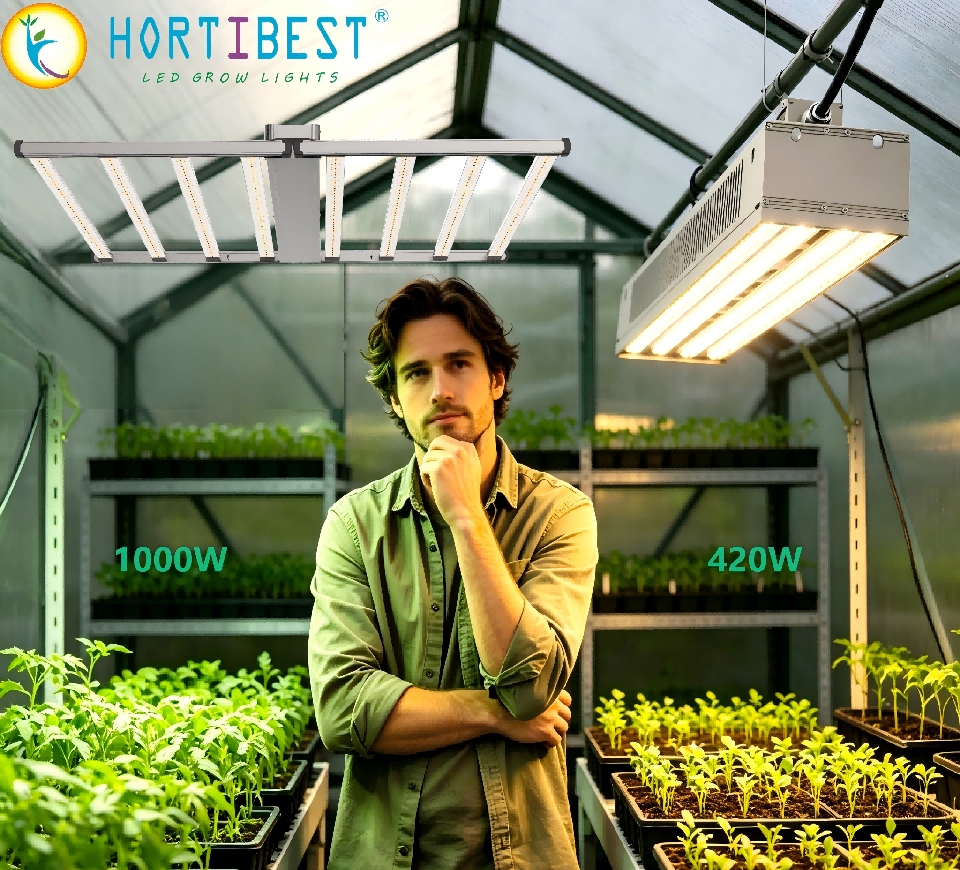

A lot of new growers automatically think higher wattage equals better growth. But that’s not always true. The right grow light depends entirely on your grow space size, plant growth stage, planting density, and monthly electricity budget—not just a number on the fixture.

Today we break down exactly who should use 1000W lights,who is better off with 400W lights, and how to make the perfect choice for your own grow setup—tailored to real-world cultivation needs across global markets.

What’s the Real Difference Between 1000W and 400W Range Grow Lights?

Wattage only tells you power consumption. What really matters are PPF Photosynthetic Photon Flux 、PPFD Photosynthetic Photon Flux、 Density coverage area and energy efficiency.
1000W grow lights: Offer higher total light output, wider uniform coverage ideal for commercial setups and stronger canopy PPFD at 1000-1650 μmol/m²/s. Designed for large spaces dense planting and crops that demand high light intensity in the late vegetative and full bloom stages.

400W range grow lights: Deliver balanced output, genuine average PPFD ranging from 380–500 μmol/m²/s, and lower power draw. Perfect for small to medium grows, specialty crops, and growers who want to save electricity without sacrificing crop quality.


Neither one is universally better—they are built for different grow scenarios, catering to the diverse needs of global growers.

Choose 400W Range Grow Lights If These Match Your Situation:

  • You have a small indoor tent ranging from 2'×2' to 3'×3' shelf grow or personal greenhouse

  • You grow premium strawberries, heirloom cherry tomatoes, rare ornamental flowers, or specialty medicinal plants

  • You focus on seedling and vegetative stages or grow low to medium light demand crops. Common leafy greens only need 10 to 50W ,so 400W range models are more than sufficient for basic varieties

  • You want to keep electricity costs low month over month, especially with long daily lighting cycles

  • Your planting density is not overly crowded, or you’re a small-scale operator prioritizing quality over massive yields

    400W range lights deliver the ideal PPFD range for most high value small scale crops. The light coverage is concentrated and even with no over lighting no leaf burn and much lower daily power consumption.


Choose 1000W Grow Lights If These Match Your Situation:

  • You run a commercial greenhouse, large indoor grow room, or multi-tier vertical farm
  • You use multi-layer rack cultivation and dense canopy planting where deep light penetration is critical
  • Your crops need high light intensity during full bloom and fruiting periods
  • You want to use one single light to cover a standard 4'×4' growing area, reducing the number of fixtures and installation costs
  • You prioritize maximum yield and crop quality
1000W fixtures offer superior PPF ,such as our top models like Hortibest OG8 Tri-channel lights can provide wide uniform coverage. They maintain stable high PPFD across the entire 4'×4' canopy, supporting faster growth cycles and better flavor, color, and overall crop value for premium varieties. Hortibest’s OG8 Tri-channel fixtures also come with DLC certification, IP65 waterproofing, and 0-10V dimming—built for 24/7 commercial use in humid grow environments worldwide.


Budget & Electricity Cost You Need to Know
One big reason many growers hesitate on 1000W is running cost—and it’s a valid concern.

400W range lights consume far less power daily typically 400 to 450Wh compared to 1000Wh. For 12-18 hour daily lighting cycles, the monthly electric bill gap adds up over time. If you’re a hobby grower or small operator, 400W range models is the cost-effective sweet spot.

For commercial growers globally, however, 1000W is the more efficient long-term option. The higher yield, faster growth cycles, and premium crop quality translate to higher profits—easily offsetting the extra electricity cost. Brands like Hortibest design their 990W fixtures for durability with only 10% light decay in 5 years and energy efficiency maximizing your return on investment regardless of your location.


Quick Simple Rule to Make Your Decision

  • Space Size: 2'×2'-3'×3' → 400W; 4'×4' or larger → 1000W
  • Growing Scale: Hobby/small-scale → 400W; Commercial/vertical farm → 1000W
  • Crop Needs: Seedlings/specialty crops → 400W; Dense canopies/bloom/fruiting → 1000W
  • Budget Priority: Electricity cost → 400W; Maximum yield → 1000W


Final Thought 

Whether you choose 400W or 1000W, the best grow light is the one that fits your unique setup. For premium commercial operations, Hortibest’s 900-990W OG8-3300 delivers the performance and durability you need for 4'×4' grows. For small-scale, specialty 400W modules offer reliability and flexibility.
Related News
Read More >>
U.S. Federal Reclassification of Regulated Herbal Products: What It Means for Indoor Growers U.S. Federal Reclassification of Regulated Herbal Products: What It Means for Indoor Growers
Apr .28.2026
The 2026 federal reclassification of herb crop to Schedule III brings significant tax incentives, expanded banking access, and new opportunities for indoor growers. Learn how premium grow lighting reduces energy costs, enhances crop quality, and helps you maintain compliance in the evolving commercial cultivation industry.
Why 3-Channel Spectrum Works Best for High-Value Medicinal Crops? Why 3-Channel Spectrum Works Best for High-Value Medicinal Crops?
Apr .15.2026
Many growers mistake dimming for "light recipe" control. In 2026, true control means independent spectrum management. Using the Hortibest OG8 Tri-channel led grow light as a case study, we explore how separating Blue(450nm) ,Deep Red  (660nm) and White+FR (380-730nm) Full Spectrum channels directly impacts yield, terpene profiles, and plant morphology.
How to increase basil yield in greenhouse How to increase basil yield in greenhouse
Apr .08.2026
Basil is an essential crop for the food service industry and essential oil production. While its market price remains stable, it has a high barrier to entry—it is extremely demanding in terms of light spectrum and intensity. If even one step is mishandled, it can quickly turn from a “high-profit crop” into a “money-losing venture.”
Day-by-Day Watering Schedule for Seedlings (First 30 Days & Beyond) Day-by-Day Watering Schedule for Seedlings (First 30 Days & Beyond)
Apr .02.2026
Overwatering plants is the mistake that beginner plants growers make. No more! Follow this easy plants seedling watering schedule for happy plants seedlings that quickly grow into thriving plants.